Several commonalities or patterns concerning Shakespeare’s shipwreck plays can be found. One main conclusion is that almost all shipwrecks are caused by storms, sometimes in combination with a lee coast.
In The Comedy of Errors, the storm is mainly identified by the dark sky (the ‘obscurèd light the heavens did grant’ CE 1.1.66). That Egeon’s family was also exposed to high seas is only given away indirectly by his mention of the sea becoming calm afterwards.
In Twelfth Night, we are not easily told but have to infer ourselves in the last act from one of the allusions to high seas, that a storm was the cause: Antonio mentions how he saved Sebastian ‘from the rude sea’s enraged and foamy mouth’ (TN 5.1.72).
In Pericles there is little doubt, as the first storm is described by the Chorus and discussed by the fishermen ashore before Pericles stumbles ashore under the storm insignia of ‘thunder and lightning.’ Pericles’s ship can ride out the second storm, for it has enough sea room this time.
In The Tempest, the title alone gives away the reason for the shipwreck. From the text we can identify high winds driving the ship on a lee coast.
High winds and seas as well as dark skies had also been encountered by Margaret on her voyage to England, as she eloquently describes in Henry VI, Part 2.
The witnesses of the storm scene in Othello give similar accounts, and their reports are also nice examples of a sea which is inseparable from the sky.
The upcoming storm in The Winter’s Tale is foretold clearly enough by ‘grim’ and ‘frowning’ skies.
Shakespeare uses typically one or several of the following images to describe a storm:
- high seas and howling winds (Oth 2.1.68)
- dark skies and ‘threat’ning’ clouds (JC 1.3.8)
- sea and sky become inseparable, the horizon is no longer visible and the sea touches the sky – however not along the horizon as usual, but much more in the ‘vault of the sky’
(WT 3.3.79–84) - thunder and lightning (Per 3.1.1–6)
(The prominent storm scenes in King Lear and in Julius Caesar employ similar imagery but are, however, experienced on land.)
Coming back to shipwreck, only in King John and The Merchant of Venice, rocks and shallow waters are reported or assumed to be the cause of demise.
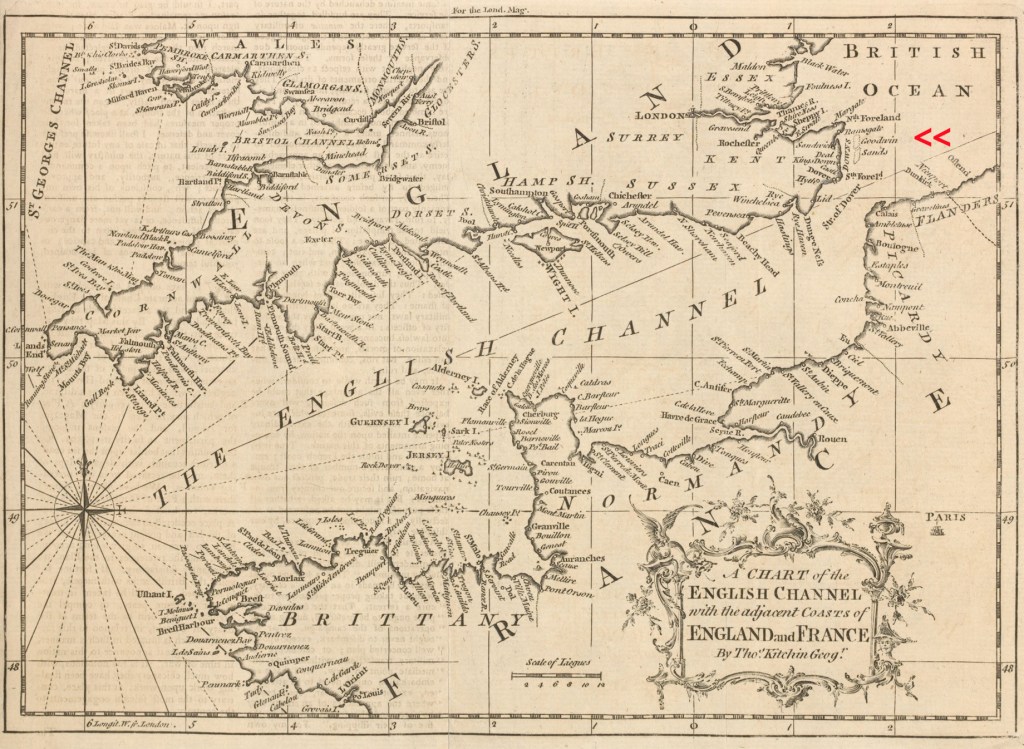
The possible locations mentioned in The Merchant of Venice are the ‘narrow seas that part / The French and English’, which is the English Channel, and the Goodwins, ‘a very dangerous flat’. Both are real, and really dangerous to navigation. The Goodwin Sands consist of sandbanks off the easternmost part of Kent and had to be passed by almost every ship approaching London. The theatregoers in London were probably well acquainted with these navigational hazards. With a tiny, but well-placed allusion, Shakespeare is able to evoke a complete mental picture in the minds of his audience.
Figure: ‘A Draught of the Goodwin Sands’; printed chart from 1750. Public domain.
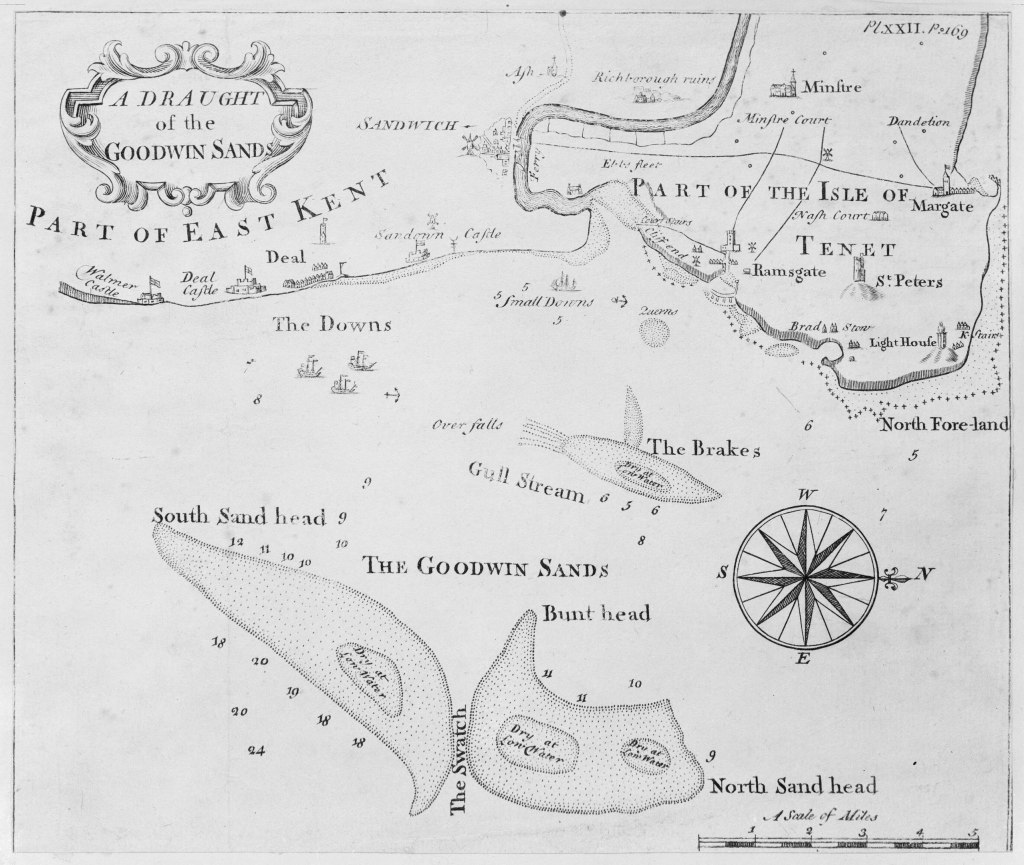
Figure: ‘A Chart of the English Channel with the Adjacent Coasts of England and France’; printed chart from 1758. New York Public Library Digital Collections.
 Shakespeare's Shipwrecks